Automation Opportunity Audit
Before you build automation, find the workflow with the clearest ROI.
The Automation Opportunity Audit maps your current workflow, estimates the cost of manual work, reviews your tools and data, and delivers a prioritized roadmap for what to automate first.
Random automation projects fail because they start with tools instead of workflow economics. The audit shows which process is worth automating, what implementation will require, what risks exist, and whether the business case justifies a production build.
Exact fee confirmed after fit review.
The Problem
Companies often start automation in the wrong place.
Someone sees a demo. A tool is purchased. A workflow is built quickly. It works in a controlled example. Then the real world appears.
The result: the automation runs for a few weeks, breaks quietly, and the team returns to manual work.
Why audit first
Building before diagnosis is how companies waste automation budgets.
You automate the wrong workflow.
The most visible process is not always the most valuable one.
You automate a broken process.
Bad process design becomes harder to fix once it is embedded in automation logic.
You underestimate production complexity.
The real cost is not the happy path. It is edge cases, errors, approvals, data quality, monitoring, and ownership.
Estimated Business Value
We baseline cost before we propose building anything.
The audit produces directional value ranges with explicit assumptions — not guaranteed ROI. Post-sprint, we review production metrics against the baseline at 30 days.
Baseline workflow cost, IPVF scorecard, prioritized opportunities
One production workflow — staging, approvals, logging, handover
Measured vs baseline: hours, touchpoints, response time
Next workflow from roadmap — proven model, not guesswork
Sample baseline (audit output)
| Workflow | Inbound lead routing (example) |
| Frequency | ~180 leads/week |
| Hours/week (all roles) | 14–22 hrs |
| Blended loaded rate | $70–$85/hr (assumption) |
| Est. monthly labor cost | $4,200–$6,800 |
| Manual touchpoints/cycle | 12–17 |
| Median routing time | 4–8 hours |
Directional value drivers (post-implementation)
| Dimension | Range |
|---|---|
| Time recovery50–70% reduction in manual execution | $45k–$72kDirectional |
| Response timeMedian routing under 30 minutes | Ops / pipeline benefitMeasured at 30d |
| Error reductionFewer mis-routes and duplicate records | $8k–$15kDirectional |
| Capacity recovered8–14 hrs/week | 0.2–0.35 FTE equiv.Directional |
Assumptions & disclaimer
Illustrative example for a mid-market B2B workflow. Your audit produces client-specific baselines and ranges — not guaranteed financial outcomes.
Estimates exclude change management and internal project time unless scoped. Actual results depend on data quality, adoption, and system behavior. Inferon Labs does not guarantee financial outcomes.
IPVF
How we measure and prioritize automation value.
The Inferon Production Value Framework scores each workflow across ten business dimensions — so recommendations are based on economics and risk, not tool hype.
Process Cost
HighWhat does this workflow cost in people-time?
~$4k–$8k/mo labor drag (example range)
Time Recovery
HighHow many hours shift from manual to automated?
12–18 hrs/week directional
Error Reduction
MedWhat rework or bad data does manual work create?
Assignment errors, duplicate records
Revenue Leakage
MedWhere do delays lose pipeline value?
Speed-to-lead, stale opportunities
Response Time
HighHow fast do items reach the right owner?
6h → <30 min median (illustrative)
Team Capacity
HighWhat capacity returns to higher-value work?
0.3–0.5 FTE equivalent monthly
Customer Experience
MedWhere do customers feel delay or inconsistency?
SLA adherence, repeat contacts
Operational Visibility
MedCan leadership see status without chasing people?
Audit trail, status dashboards
Scalability
HighCan volume grow without linear headcount?
Bottleneck role dependency
Risk Reduction
HighWhat fails silently? What needs approval?
Approval gates, incident history
Scores shown are illustrative for a sample workflow. Your audit produces client-specific ratings with documented assumptions.
Deliverables
What you receive at the end of the audit.
Every deliverable is designed to create decision-ready clarity, whether or not you proceed to implementation.
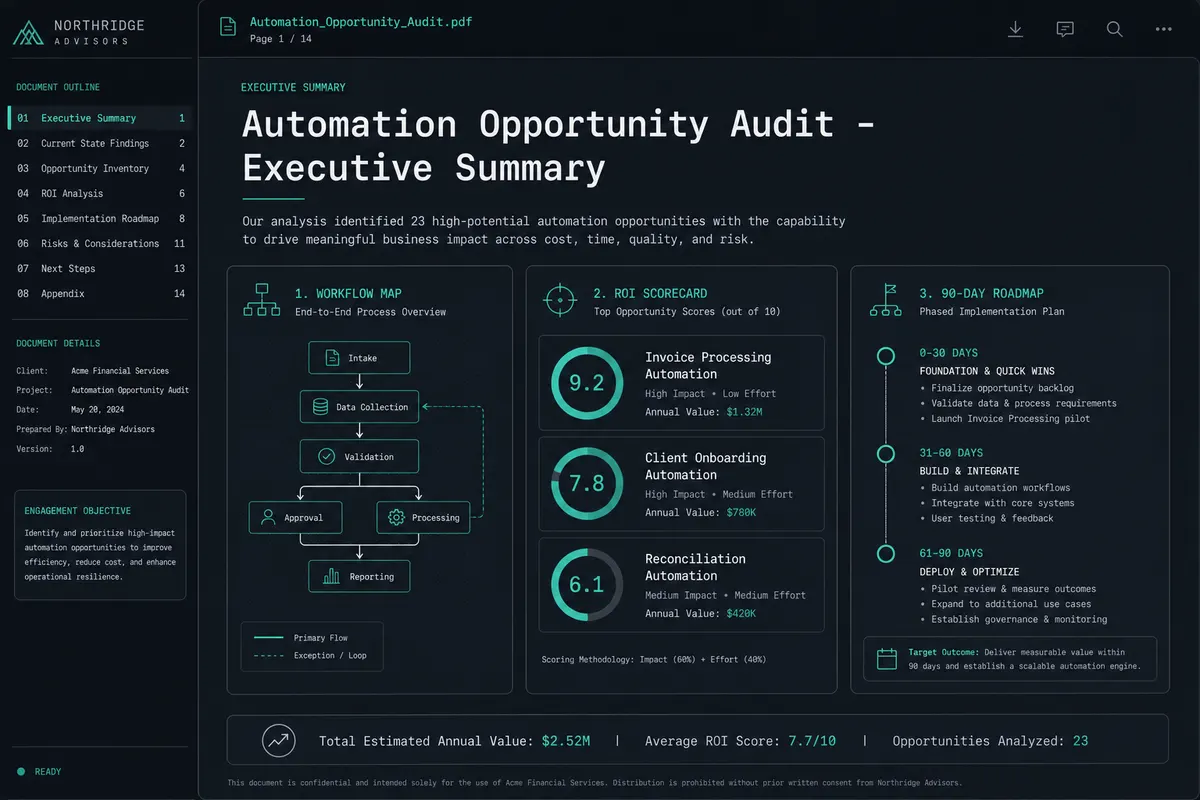
Current-state workflow map
Triggers, tools, roles, handoffs, and failure points — as the process actually runs today.
IPVF scorecard
Ten-dimension assessment of process cost, risk, capacity, visibility, and scalability.
Cost-of-manual-work estimate
Hours, blended rates, touchpoints, and directional monthly labor drag.
Automation opportunity register
Prioritized opportunities ranked by business value × implementation feasibility.
Estimated business value ranges
Directional annualized value, payback sensitivity, and explicit assumptions.
Technical architecture (to-be)
Integrations, orchestration, approval paths, logging, and staging approach.
Risks, assumptions & success metrics
What must be true — plus baseline metrics for 30/90-day production review.
90-day implementation roadmap
Recommended sprint scope, sequence, and expansion plan.
Executive summary
One-page business case for leadership and budget owners.
Timeline
Most audits complete in 5–10 business days.
Exact timeline depends on stakeholder availability and workflow complexity.
Right fit
Who the audit is designed for.
Good fit
- B2B companies with manual workflows and unclear starting point.
- Teams that have been burned by automation projects that didn't deliver.
- Operators building a business case before approving a larger build.
- RevOps, SupportOps, COOs, and founders who want clarity before implementation.
Not a fit
- Personal productivity automations or simple one-off Zapier tasks.
- Companies looking for the cheapest possible automation.
- Teams unwilling to provide workflow access or stakeholder time.
- Companies looking for a free strategy document before committing.
Investment
Typical range: $2,500–$7,500
Audit engagements typically range from $2,500 to $7,500. The exact scope depends on workflow complexity, stakeholder access, and the depth of technical review required.
Typical investment range. Exact scope and fee confirmed after audit fit review.
You can use the audit internally even if Inferon Labs does not build the implementation. The deliverable is designed to help leadership make a clear decision.
The audit is not an expense. It is the due diligence that prevents you from building the wrong automation.
Risk reversal
If the audit does not identify clear business value, we discuss next steps.
If the audit does not identify at least three automation opportunities with clear business value, Inferon Labs provides a full refund. Terms are confirmed in the audit agreement before work begins.
Audit FAQ
Common questions about the audit.
Production-grade automation should be evaluated carefully. These are the questions worth asking upfront.
Start with clarity before you build.
If your team knows manual work is expensive but is not sure where to start, the audit is the right first step.
Fit review confirms scope, timeline, and whether the audit is likely to produce a strong business case.